16 Aug
2022
PAT (Physics Aptitude Test)
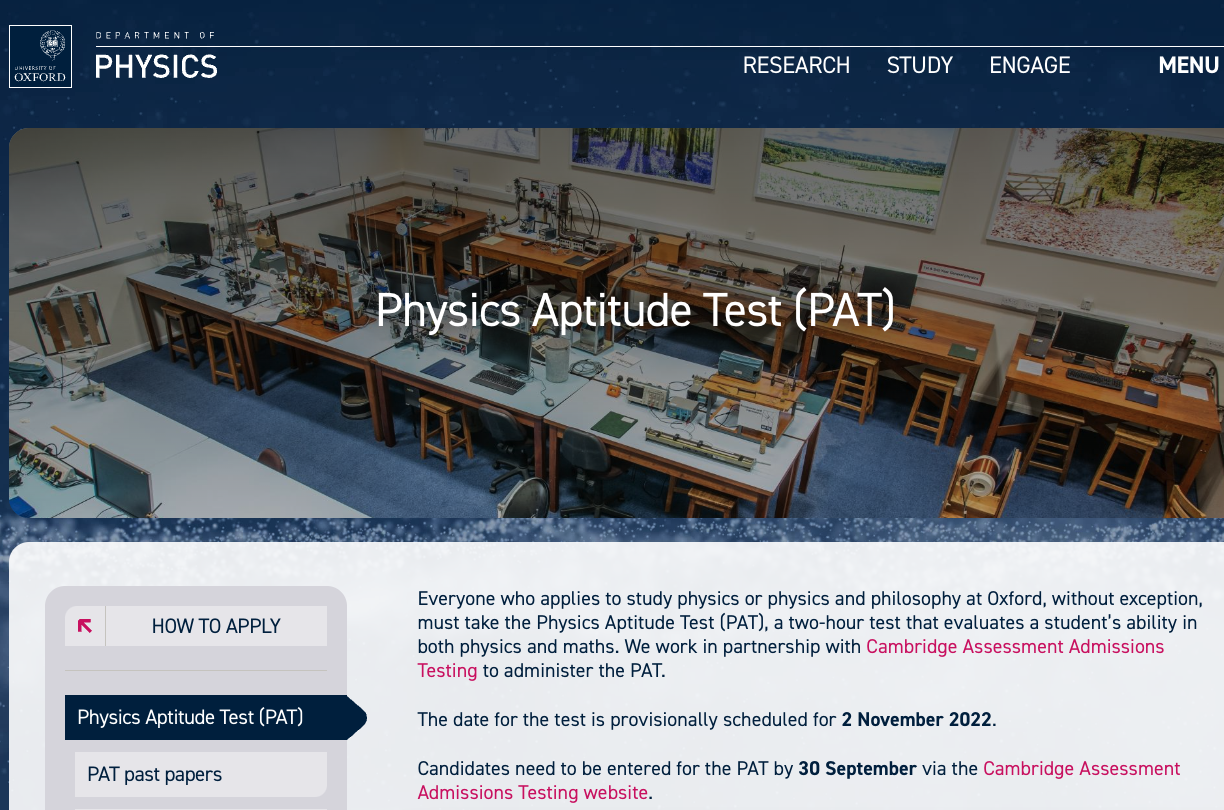
<p>Performing well in the PAT requires extensive preparation over a long period of time. Completing the past papers and having your work analysed by a tutor is important but you will also need to attempt many extra problems alongside this. The reason for this is that the test is becoming more difficult and unpredictable so being able to make progress in a question which is unfamiliar to you is vital. </p><p><br> </p><p>It's best to start your preparation early - cramming does not work for the PAT as you will need to be well rested to achieve your potential. I am able to advise students on the best approach for optimal performance.</p><p><br> </p><p><strong>Introduction</strong><br> </p><p>2-hour examination with a Mathematics section and Physics section. The test is set by the University of Oxford. The following university/ courses requires applicants to sit PAT:<br> </p><p>[Oxford]</p><p>Physics</p><p>Engineering</p><p>Materials Science</p><p> </p><p><strong>What is the level/standard of PAT exam? Is A2/ Physics enough or would you say beyond?</strong></p><p><a target="_blank" rel="noopener noreferrer" href="https://www2.physics.ox.ac.uk/study-here/undergraduates/applications/physics-aptitude-test-pat/pat-syllabus">https://www2.physics.ox.ac.uk/study-here/undergraduates/applications/physics-aptitude-test-pat/pat-syllabus</a></p><p> </p><p>The syllabus is mostly AS topics with some A2 included as well. The questions set in the exam are restricted to this material but can still be very challenging. Therefore the syllabus of the exam is not beyond A2 but the level of the questions is. It is possible to set very difficult questions from standard material and this is the kind of practice it is best to focus on.</p><p><br><strong>What are the techniques needed in PAT exam? </strong><br> </p><p>You will need to be fluent in all parts of the syllabus. Beyond this you will need to be well practised at attempting questions which are initially unfamiliar. It is wise not to look for repetition or fixed techniques because the examiners have to keep on changing the target otherwise candidates will score too highly. Being able to work quickly is not as vital as it is for other exams such as the Cambridge entrance tests. It used to be the case that mental arithmetic was important but although you are now allowed a calculator it is still useful to be able to spot simplifications and work efficiently.<br> </p><figure class="image"><img src="https://oxbridge-blogs-1.s3.ap-northeast-2.amazonaws.com/5MFPRZTv1O4ex0FT1fP6.png"></figure><p> </p><p><strong>How to prepare for PAT?</strong></p><p> </p><p>Useful work can be done from the moment you decide to apply. If you start your preparation before June then you can try early Isaac Physics questions, the AS Physics Olympiad and the STEP support programme. It is best to start around June/July. There is a wealth of resources beyond past papers, such as those mentioned above, later rounds of the Physics Olympiads, iwanttostudyengineering, Brilliant and Next Time Questions. I also have many resources to draw on, including my own 5 mock papers. The PAT past papers should be seen as a minimum for preparation but any advanced work from the above sources will help also. Problem-solving practice should be seen as the most effective way to achieve success - it is much more important than memorising formulae or reading notes.</p><p> </p><p><strong>When do the results come out? Is it possible to know the results before the Oxford interviews?</strong><br> </p><p>Around the end of November/early December. Don’t try to guess your mark or the pass mark by visiting online forums - it is best to prepare fully then you don’t have to worry about the result as much. It isn’t possible (or relevant) to find out your PAT mark before the interviews.<br> </p><p><strong>Last word of advice for applicants? </strong></p><p> </p><p>The catchphrase of the Isaac Physics website is “You work it out”. You have to get used to solving problems by yourself even if learning to do so is time-consuming to begin with. Do lots of extra preparation without using solutions too soon. If your first attempt doesn’t work keep trying.</p><p> </p><p>You should aim to become ‘stable’ so that in the interview you only need minimal guidance in order to solve the problem. Achieving this is just a matter of doing the correct amount of practice on the right type of problems.</p><p> </p><p><strong>FAQ</strong></p><p>Where can I download past papers?</p><p><a target="_blank" rel="noopener noreferrer" href="https://www2.physics.ox.ac.uk/study-here/undergraduates/applications/physics-aptitude-test-pat/pat-past-papers">https://www2.physics.ox.ac.uk/study-here/undergraduates/applications/physics-aptitude-test-pat/pat-past-papers</a></p><p> </p><p>When and where do I register for PAT?</p><p>Registration deadline is 15th October and can be done either through your school (if registered as a test center) or an authorised test center which can be found at </p><p><a target="_blank" rel="noopener noreferrer" href="http://www.admissionstestingservice.org/find-a-centre">http://www.admissionstestingservice.org/find-a-centre</a></p><p> </p><p>Where can I take PAT?</p><p>Either at your school (if registered as a test center) or at an authorized test center which can be found at http://www.admissionstestingservice.org/find-a-centre</p>