16 Aug
2022
STEP
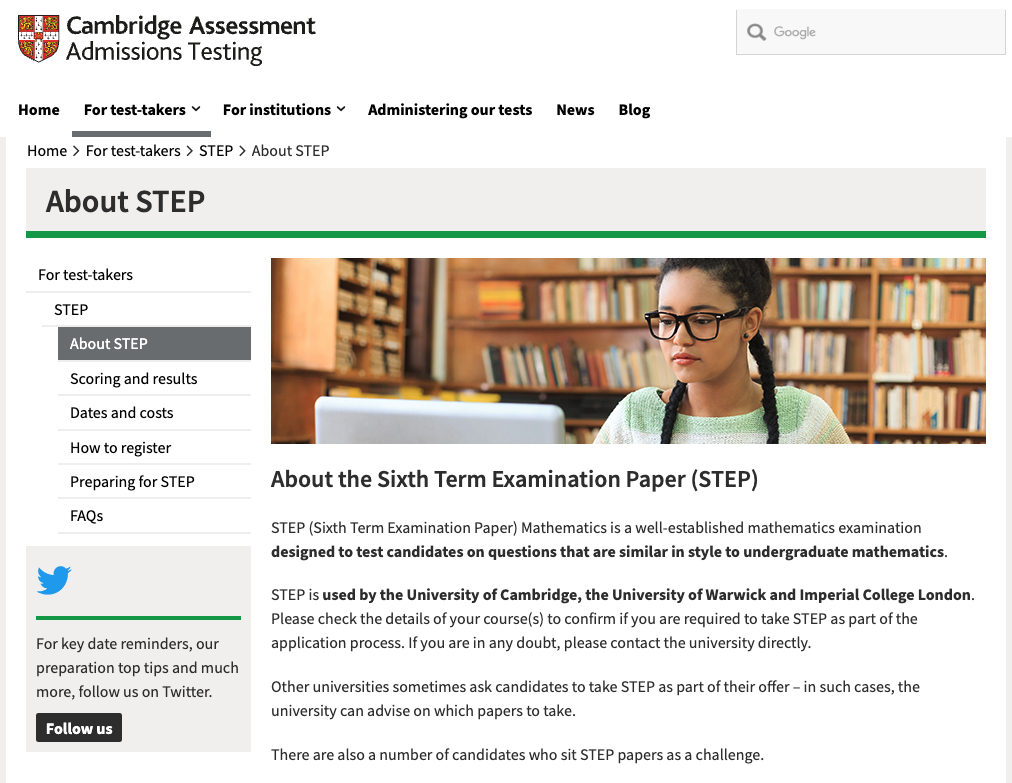
<p><strong>Introduction</strong></p><p> </p><p>STEP is an admissions test primarily for students applying to degrees that involve mathematics. In contrast to many other admissions tests, STEP is usually taken the following year, after the interviews which are held in December. </p><p> </p><p>The registration deadline is end of April (for standard applicants) and end of May (for late entry applicants). Registration can be done either through your school (if your school is registered as a test centre) or at an authorised test centre, a list of which can be found at: <a target="_blank" rel="noopener noreferrer" href="http://www.admissionstestingservice.org/find-a-centre">www.admissionstestingservice.org/find-a-centre</a>. Candidates sit for the STEP at the place where they registered for the STEP (either your school or an authorised test centre). Results are released in August of the same year in which you took the test.</p><p><br> </p><p>The STEP exam has 3 papers: STEP I, STEP II as well as STEP III. Each paper is 3 hours long, and the final mark for each paper is based on your 6 highest scores (you can answer as many questions as you like but only the scores for your best 6 questions will be counted). <br> </p><p>What paper you have to sit for depends on the university that you’re applying to. Typically, a Cambridge mathematics candidate will be required to achieve 1/1 or higher in the STEP II and III papers. STEP I is usually not required. On the other hand, candidates for other degrees may only be required to take STEP I and possibly STEP II (scores above 2 are usually acceptable).</p><p> </p><p>The following courses in the respective universities may require applicants to take STEP:</p><p> </p><figure class="table"><table><tbody><tr><td>Cambridge</td><td>Mathematics, Computer Sciences, Economics, (Chemical) Engineering, Natural Sciences</td></tr><tr><td>Imperial, Warwick </td><td>Mathematics</td></tr></tbody></table></figure><p><strong>Format</strong></p><p> </p><p>STEP questions are very different from the questions typically encountered in high school Mathematics exams. Instead, they bear a strong resemblance to the Cambridge Mathematical Tripos exams. <br> </p><p>A typical question takes approximately 30-40 minutes to complete. There is no particular pattern to the type of questions that come up. But there is usually a full question on Calculus and a full question on Algebra (equations). There might be a pure question related to series or number theory (often induction). In addition, probability, statistics or mechanics feature in 2 or 3 questions.</p><p> </p><p>Generally, the STEP questions are self-contained and conceptually simple. They are not meant to test a candidate’s knowledge of specific formulas or topics. Indeed, examination papers include formula booklets which contain all the formulas and results for the relevant syllabus, so there is no need to memorise any particular formulas. Calculators are not needed for STEP. You will not need to perform any complex arithmetic.</p><p> </p><p>What the STEP questions do test, is a student’s mathematical understanding, clarity of expression and ability to think conceptually. For example, a question may introduce a new technique or method, which the candidate then has to apply in an innovative way.<br> </p><figure class="image"><img src="https://oxbridge-blogs-1.s3.ap-northeast-2.amazonaws.com/ynY4Va37zsN8C5KPu5cc.png"></figure><p> </p><p><strong>STEP Scoring</strong></p><p> </p><p>The STEP exam adopts the following grading system:<br> </p><p>S – Outstanding</p><p>1 – Very good</p><p>2 – Good</p><p>3 – Satisfactory</p><p>U – Unsatisfactory<br> </p><p>Each question is marked out of 20 marks, and there is no bias towards specific topics (for example, 5 pure math questions are no different from 3 mechanics and 2 probability related questions). <br> </p><p>Moreover, there is no preference for any method (unless explicitly stated in the question) as long as the answer provided is justified and correct. A typical offer to read Mathematics at Cambridge will require a 1/1 for the STEP II and III papers. Often, answering 4 questions well will be sufficient to earn a score of 1 but this varies from year to year.</p><p> </p><p><strong>What level of difficulty is STEP pegged at? </strong><br> </p><p>The STEP I and STEP II papers generally revolve around the A-level Mathematics syllabus. Some topics that come up in the STEP exam are not taught in the IB course so it can be beneficial for IB students to have a look through the A-Level syllabus beforehand. </p><p> </p><p>Although both the STEP I and II papers are based on the same A-level syllabus (which includes pure mathematics, mechanics, probability and statistics), STEP I questions tend to be shorter and less tricky. They are only slightly harder than questions encountered in the A-level or IB exam. </p><p> </p><p>The STEP III paper focuses on the Further Mathematics syllabus. In particular, complex numbers, hyperbolic functions, series as well as differential equations are very common topics. Rough guide to the current syllabus can be found at the official website.<br> </p><p><strong>Preparing for the STEP Exam</strong></p><p> </p><p><i>Practising Past Papers</i></p><p> </p><p>Your first stop should be Stephen Siklos’s guide to the STEP exam, which explains the format of the questions and provides sample solutions: </p><p> </p><ul><li><a target="_blank" rel="noopener noreferrer" href="https://www.maths.cam.ac.uk/sites/www.maths.cam.ac.uk/files/pre2014/undergrad/admissions/step/advpcm.pdf">www.maths.cam.ac.uk/sites/www.maths.cam.ac.uk/files/pre2014/undergrad/admissions/step/advpcm.pdf</a></li><li><a target="_blank" rel="noopener noreferrer" href="http://www.openbookpublishers.com/product/342/advanced-problems-in-mathematics--preparing-for-university">www.openbookpublishers.com/product/342/advanced-problems-in-mathematics--preparing-for-university</a></li></ul><p> </p><p>The best way to prepare for STEP is by practicing past exam questions. It is normal for candidates to take a long time to answer the questions in the beginning, so don’t be discouraged. <br> </p><p>STEP questions emphasise the use of several techniques and concepts that are not taught in the high school Math course. A particularly important technique is the ability to visualize questions, especially graph sketching questions. The same concepts tend to come up over the years, so with sufficient practice you will become familiar with many of the techniques that you can apply. This will then improve the speed at which you answer questions.<br> </p><p>If you are an IB student, it may be a good idea to practise STEP I papers even though they are not required for Cambridge Mathematics applicants. The STEP I papers will help you get accustomed to the A-level syllabus that is also used by the STEP II papers. </p><p> </p><p>The past papers for STEP can be located at the following website: </p><p><a target="_blank" rel="noopener noreferrer" href="http://www.admissionstestingservice.org/for-test-takers/step/preparing-for-step/">www.admissionstestingservice.org/for-test-takers/step/preparing-for-step</a></p><p> </p><p><i>Time management</i></p><p> </p><p>This is a key part of the STEP exam. It is much better to finish 3 or 4 questions completely rather than attempt 6 questions partially. On average, a question can take as long as 40 minutes to answer and it is normal to be stuck for several minutes before finally obtaining the answer.</p><p> </p><p><strong>When Should I Take the STEP?</strong></p><p><br>Some students often ask if taking STEP in their lower sixth year might be advantageous. This depends on the degree and university that you are applying to. A good score can improve your application (since the admissions tutor will see that you’ve already secured the necessary STEP score), but it also takes a lot of time to prepare for the STEP exam. </p><p><br>Many students applying to Cambridge to do Mathematics will take STEP I in their lower sixth year as practice for STEP II and III. This is not as common for candidates applying to read other subjects. For such candidates, it is probably a better use of your time to read up on the course that you are intending to apply to.</p>